

The History of Dyslexia: From “Word Blindness” to What We Know Today
Learning Differences
Dyslexia , Learning & Thinking
In November 1896, a doctor in the English seaside town of Seaford wrote up an unusual patient.
Percy F. was 14. He was bright, intelligent, and quick at games. He could not learn to read. His schoolmaster believed Percy would be “the smartest lad in the school” if every lesson were taught out loud.
When Dr. W. Pringle Morgan asked Percy to write “Now you watch me while I spin it,” Percy wrote: “Now you word me wale I spin if.”
Morgan published the case in the British Medical Journal as “A Case of Congenital Word Blindness.” It is often cited as the first written description of what we now call dyslexia.
Where the Word “Dyslexia” Came From
Morgan didn’t start from scratch. In 1877, German physician Adolph Kussmaul coined the term “word blindness” for adults who lost the ability to read after a brain injury, even though their sight, intellect, and speech were intact.
In 1887, German ophthalmologist Rudolf Berlin gave the difficulty another name: dyslexia, from the Greek for “difficulty with words.”
Both men were describing adults who had lost a skill they once had. What Morgan added was the child: someone who never acquired reading in the first place, despite intelligence and effort.
The First Champions of Struggling Readers
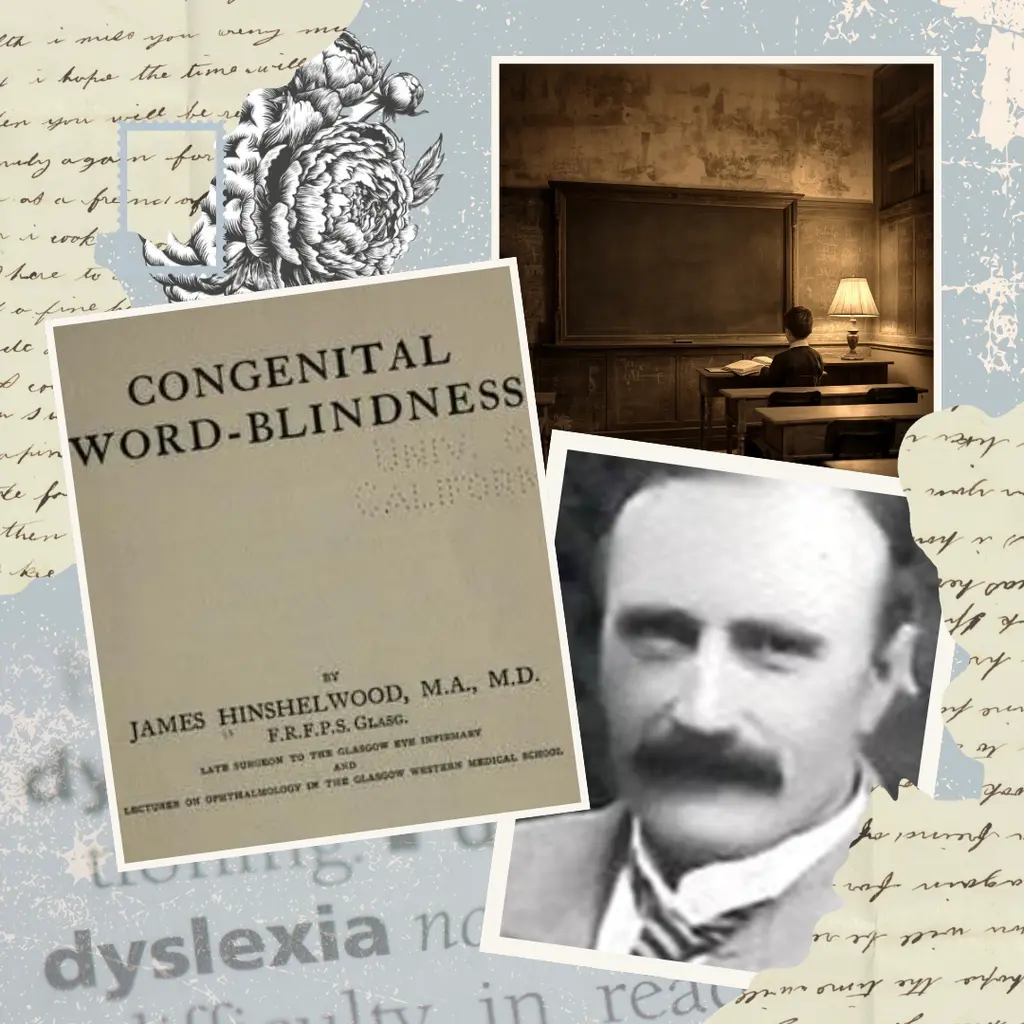
Scottish eye doctor James Hinshelwood took the work further. Through the early 1900s, he published case after case of children with “congenital word blindness,” and in 1917 he gathered his findings into a book of the same name.
Hinshelwood made two arguments that were ahead of their time. He believed word blindness in children could be remedied. And he believed teachers were well placed to notice it early.
The Myth That Stuck
“Word blindness” pointed to the eyes, and the idea lingered for decades. In the 1920s, American physician Samuel Orton described “twisted symbols,” which helped cement the popular belief that dyslexia means seeing letters backwards. Orton also estimated that more than one in ten schoolchildren struggled with reading, far more than earlier doctors had imagined.
A century of research since then suggests dyslexia is rooted mainly in how the brain processes language, not in how the eyes see. Letter reversals are common in all young children learning to read. They are not the defining sign of dyslexia.
What the History Teaches
Children like Percy were there all along. What changed was how closely the adults around them looked.
Reading draws on many systems at once: language, memory, attention, perception. When one link is weak, the whole chain struggles. That’s why NILD Educational Therapy® looks at the whole learner and builds the thinking underneath the skill, not just the skill itself.
Every step forward in this story started with someone choosing to look closer. That work continues in classrooms, therapy rooms, and at kitchen tables today.
Where to Go From Here
Parents: If your child sounds a little like Percy, you don’t have to wait for answers. Find an NILD educational therapist →
Educators: Learn to respond to struggling learners with research-based, cognitive intervention. Explore NILD Educational Therapy courses →
Schools: Equip your whole team to notice and respond. Talk with our team →
Sources
- Morgan, W. P. (1896). A case of congenital word blindness. British Medical Journal, 2, 1378.
- Hinshelwood, J. (1917). Congenital Word-Blindness. London: H. K. Lewis & Co.
- Orton, S. T. (1925). “Word-blindness” in school children. Archives of Neurology and Psychiatry, 14, 581–615.
- University of Oxford, A Brief History of Dyslexia
- LD OnLine, Timeline of Learning Disabilities
Image alt text: “Title page of the 1917 book Congenital Word-Blindness by James Hinshelwood, M.A., M.D., published by H. K. Lewis & Co. Ltd., London.”